HR for small businesses
What is an HR system? A practical guide for small businesses
Bring employee records, documents, working time and absence together without adding more tools than you need.
Time tracking
Do you have to record your employees’ working time? In the EU, generally yes. Here is what the 2019 EU Court of Justice judgment requires, how it links to the Working Time Directive, who may be exempt and how to choose a system.
9 min read
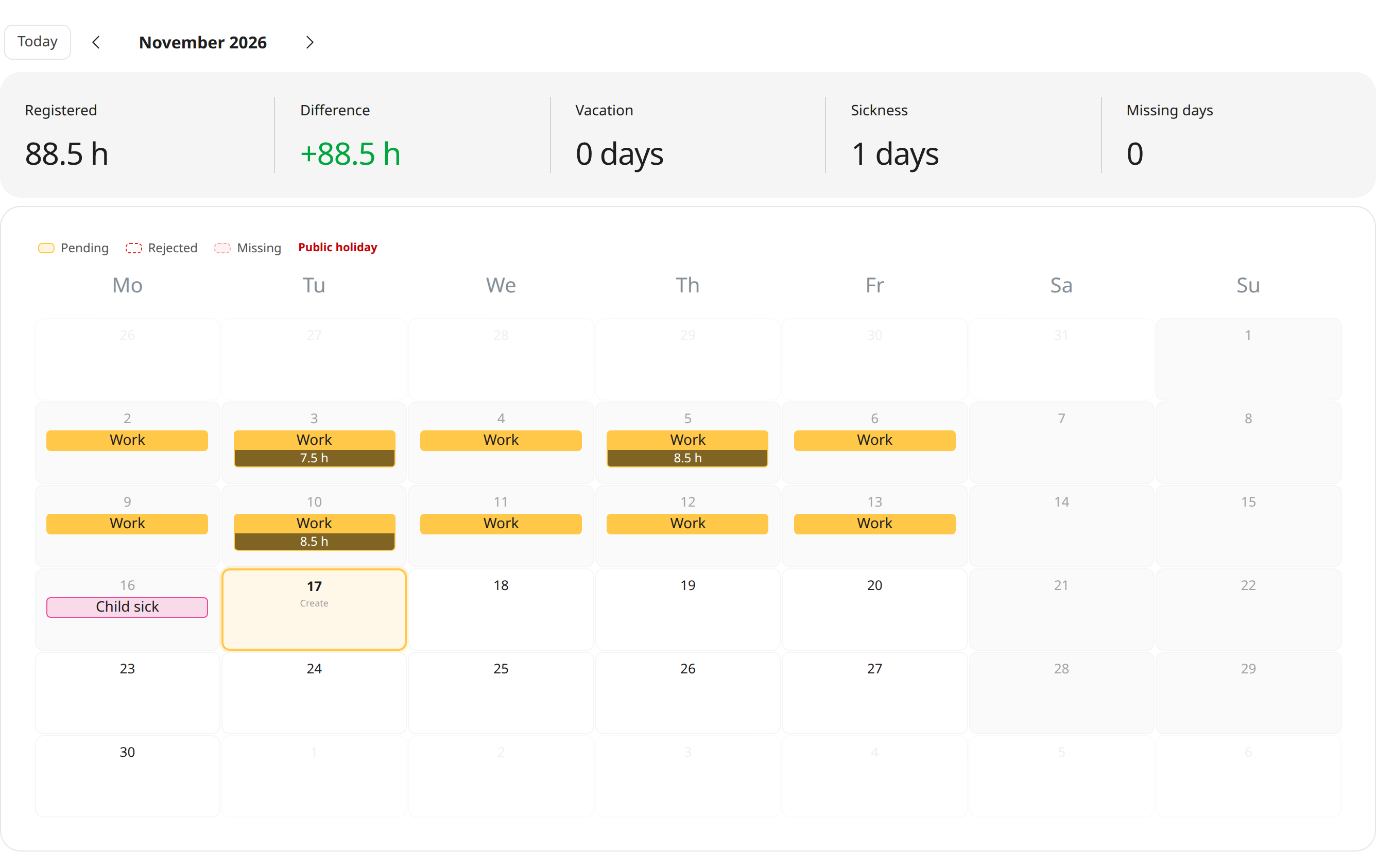
Across the EU, employers are generally expected to have a system that measures how long each worker works every day. The requirement comes from a 2019 judgment of the Court of Justice of the European Union, and member states are putting it into national law. The system must be objective, reliable and accessible. The details, such as how long records must be kept and who is exempt, depend on your country.
Short answer: in most EU countries, generally yes. The obligation is not limited to large employers; in principle it can apply whether the business has two or 200 employees. Member states may adapt the rules to particular sectors and, in some cases, to the size of a business, and there are exemptions described further down. How it applies to you depends on your country’s legislation.
In its judgment of 14 May 2019 in case C-55/18 (CCOO v Deutsche Bank), the Court of Justice of the European Union held that member states must oblige employers to set up an objective, reliable and accessible system for measuring each worker’s daily working time. Without such records, the Court said, it is not possible to check that the limits in the Working Time Directive (2003/88/EC) are respected. Member states implement the requirement in national law at different speeds and with different details, and in some countries the rules are still being adapted, so check the current position with your national labour authority.
The judgment requires records, but does not prescribe a particular technology or time tracking tool. Each country decides the specific form, and businesses can usually choose their method as long as it meets the national requirements. In practice, the system should make it possible to:
The rules generally apply to employees. The Working Time Directive allows member states to exempt certain workers whose working time is not measured or predetermined, or can be set by the workers themselves, such as managing executives and others with autonomous decision-making powers. Countries use these exemptions differently, and collective agreements can also affect the position. An exemption depends on the actual role and relevant agreements; a job title alone is not decisive. Seek advice if you are unsure.
The right choice depends on the work and your processes. Whatever the method, records should reflect actual working time and be accessible to employees. A spreadsheet can be used, but the business must manage access, corrections, security and retention throughout the required period.
Records help employers monitor the limits in the Working Time Directive. As EU minimum standards, workers are entitled to 11 consecutive hours of daily rest in every 24-hour period and an uninterrupted weekly rest of 24 hours, plus the daily rest, in every seven-day period. Average weekly working time, including overtime, must not exceed 48 hours, usually calculated over a reference period of up to four months. National law and collective agreements can set stricter limits or allow certain derogations, so check the rules that apply to you.
Time records contain personal data covered by the GDPR. Limit access to people with a work-related need, inform employees about the purpose and retention, and use appropriate security. Keep records for the period your national law requires and then handle them under the company’s deletion policy and other legal obligations.
Weekplace brings time tracking, fixed schedules and employee administration together. Learn more about time tracking for small businesses and see whether it fits your needs.
Generally, yes. Following the EU Court of Justice judgment of 14 May 2019 in case C-55/18, member states must require employers to have an objective, reliable and accessible system for measuring each worker’s daily working time. How and from when this applies depends on your country’s national law.
From the EU Court of Justice judgment of 14 May 2019 in case C-55/18 (CCOO v Deutsche Bank), which interprets the Working Time Directive (2003/88/EC). Member states implement it in national law, at different speeds and with different details.
In principle, yes: the obligation is not limited to large employers. The Court allowed member states to take account of the particular features of each sector and the size of certain businesses, so check whether your country has special rules for small employers.
Employers with employees generally need a system for recording daily working time. Exemptions exist for certain roles and vary by country, so they require an assessment of the specific situation.
The requirement is that daily working time can be measured. It does not in itself require you to record which tasks the time was spent on, although national rules or your own needs may call for more.
It depends on your country. The EU judgment does not set a retention period, so national law decides how long records must be kept. Check with your national labour authority.
Not necessarily. The judgment does not prescribe a particular technology, but the system must be objective, reliable and accessible. Some countries set more specific requirements, so check your national rules.
Employees should be able to access their own records. Access to colleagues’ personal data should be limited according to company access rules and data protection obligations under the GDPR.
Keep employee details, time tracking, vacation and key documents in one straightforward system.
Try for freeHR for small businesses
Bring employee records, documents, working time and absence together without adding more tools than you need.
Vacation overview
Make vacation planning easier with one shared view of requests, approvals and team coverage.
Equipment
A simple record of issue, ownership and return makes company equipment easier to track.